
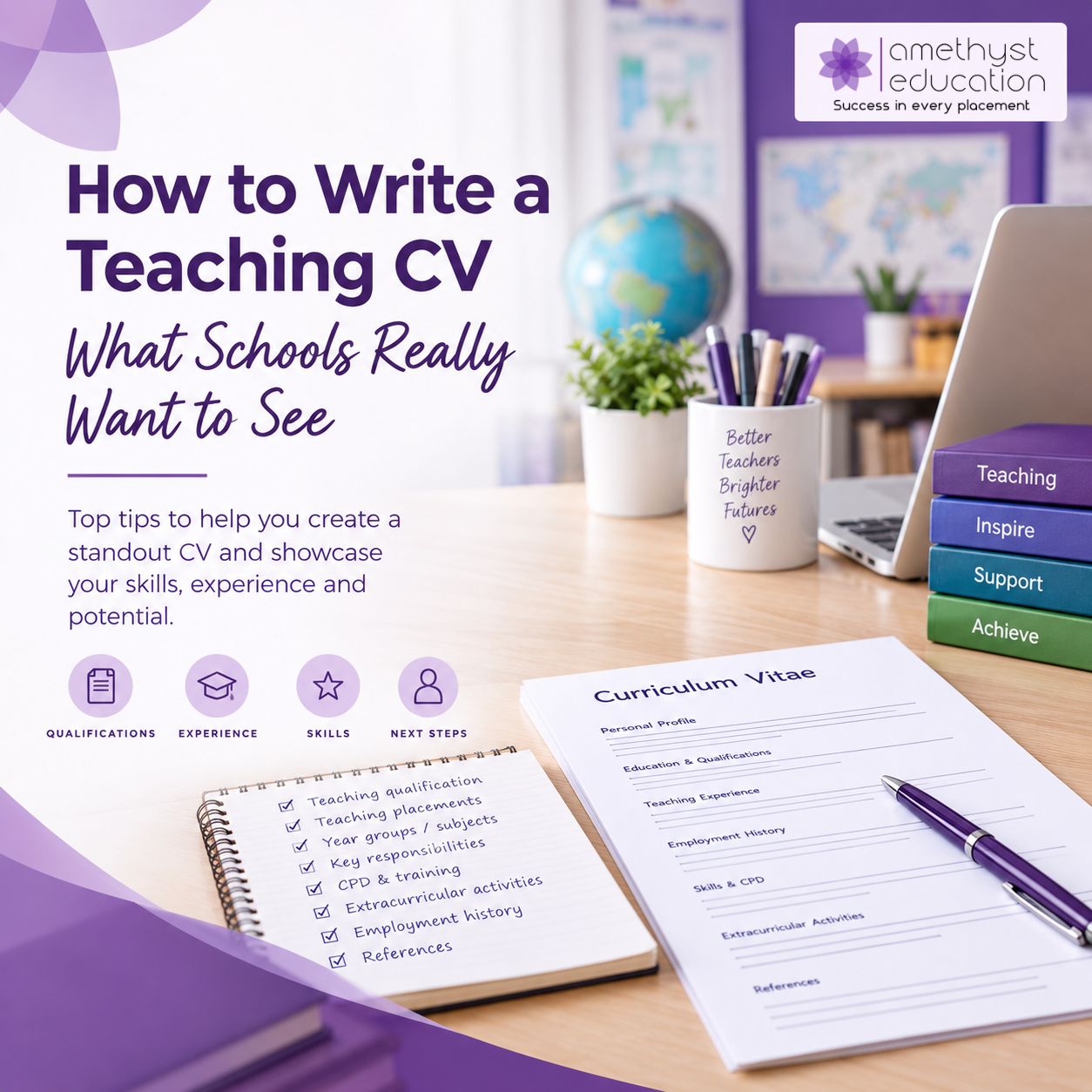
How to Write a Teaching CV as an ECT: What Schools Really Want to See
Writing your first teaching CV can feel daunting.
If you’re an ECT or trainee teacher, you may look at your CV and wonder whether you have enough experience to include.
The good news? You probably have far more relevant experience than you think.
One of the biggest mistakes we see when reviewing CVs from trainee teachers is surprisingly simple:
They don’t include their teacher training!
Your teacher training is one of the most important things on your CV, so make sure it is clearly included, even if you haven’t completed it yet.
Here are our top tips for writing a teaching CV that gives schools a clear picture of your experience and qualifications.
1. Make Your Teacher Training Clear
Believe it or not, one of the most common things missing from a trainee teacher’s CV is their teaching qualification.
If you are currently completing your teacher training, include it!
You don’t need to wait until you have qualified.
Clearly state:
- The teaching qualification you are studying towards
- Your training provider/university
- The dates of your training
For example:
PGCE Secondary Mathematics with QTS
University/Training Provider – 2025–2026
Or:
BA (Hons) Primary Education with QTS
University/Training Provider – 2023–2026
Schools need to be able to quickly identify what you are qualified in, or what you are currently training towards.
2. Include Your Teaching Placements
As an ECT or trainee teacher, your teaching placements are incredibly valuable experience.
Even though they aren’t necessarily permanent employment, they demonstrate that you have experience working in schools and teaching pupils.
Make sure you include your placements on your CV.
For each placement, include:
School Name
Trainee Teacher – Subject/Age Group
Dates
Then briefly explain what you did during the placement.
You can use either paragraphs or bullet points — there is no requirement for one particular format.
For example:
- Planned and delivered Mathematics lessons to KS3 and KS4 pupils.
- Differentiated lessons to support students with a range of abilities and learning needs.
- Assessed student work and monitored progress.
- Developed positive relationships with pupils and supported effective classroom management.
- Participated in departmental meetings and parent communication where appropriate.
Keep the information factual and relevant.
3. Tell Schools Which Year Groups You’ve Taught
Don’t simply write:
“Completed school placement.”
Schools want to know who you’ve actually taught.
Have you taught:
- EYFS?
- Year 1?
- Year 4?
- Year 6?
- KS3?
- GCSE?
- A Level?
- IB?
- Sixth Form?
Make this clear on your CV.
For example:
Teaching Experience:
Year 7–9 Mathematics | Year 10–11 GCSE Mathematics
Year 1 Class Teacher
This immediately gives a school a better understanding of your classroom experience.
4. Include Your Responsibilities
You don’t need years of experience to have meaningful responsibilities.
Think about what you actually did during your placements.
Did you:
- Plan lessons independently?
- Mark and assess work?
- Track pupil progress?
- Attend parents’ evenings?
- Support SEND pupils?
- Differentiate lessons?
- Take part in departmental meetings?
- Help with school trips?
- Run an intervention?
- Support extracurricular activities?
- Have responsibility for a form group?
These are all relevant experiences.
Don’t underestimate your teaching placements.
For an ECT, schools understand that you are at the beginning of your teaching career. They aren’t expecting you to have ten years of classroom experience.
They want to see evidence that you have trained, taught and developed your skills in a real school environment.
5. Don’t Forget Extracurricular Activities
Have you been involved in anything outside your normal teaching timetable?
Make sure you include it.
Perhaps you have:
- Run a sports club
- Helped with a school production
- Supported a debating club
- Assisted with a school trip
- Run a reading club
- Supported a STEM activity
- Helped with school competitions
- Coached a school team
- Organised an extracurricular activity
These experiences can help demonstrate that you are willing to contribute to the wider life of a school.
And if you have a particular passion or skill outside your subject, schools may be interested in that too.
6. Include Your CPD
Don’t assume that CPD is only relevant once you’ve qualified.
If you’ve completed training or professional development during your teacher training, include the most relevant courses on your CV.
This might include areas such as:
- Safeguarding
- SEND
- Behaviour Management
- Mental Health and Wellbeing
- Assessment
- Phonics
- Curriculum Development
- Teaching and Learning
- Subject-specific CPD
- Supporting EAL learners
- Prevent
- First Aid
Focus on relevant and meaningful CPD that demonstrates your commitment to developing as a teacher.
7. Make Sure There Are No Gaps in Your Employment History
This is particularly important for anyone applying to work in schools.
Your CV should account for your entire employment history.
If you’ve had periods where you weren’t working, that’s absolutely fine.
You don’t need to hide them.
Simply explain what you were doing.
For example:
2023–2024 – Travelling
2021–2022 – Stay-at-home parent
2020–2021 – Unemployed
2019–2020 – Caring for a family member
There is nothing wrong with having gaps in your employment history.
Schools simply need to be able to understand your timeline.
This is particularly important because of safer recruitment requirements within education. Schools need a clear and accurate employment history when recruiting staff.
So don’t leave unexplained gaps because you are worried about how they look.
Be honest and factual.
8. Keep Your CV Factual
Your CV should provide schools with the facts.
It should clearly cover:
Your Education & Qualifications
Your degrees, teaching qualification and relevant qualifications.
Your Teaching Experience
Your placements, year groups, subjects and relevant responsibilities.
Your Employment History
Where you’ve worked, when you’ve worked there and what your responsibilities were.
Your Professional Development
Relevant CPD and training.
Additional Experience
Extracurricular activities and other relevant school experience.
Think of your CV as the evidence behind your application.
Your Personal Statement Is Different
Your CV and personal statement have different jobs.
Your CV tells a school what you’ve done.
Your personal statement helps a school understand who you are as a teacher.
Your personal statement is where you can talk about:
- Your teaching philosophy
- What motivates you
- Your approach to teaching and learning
- Your classroom management style
- Your strengths as a teacher
- Your relationships with pupils
- Your passion for your subject or age group
- Your commitment to pupil progress
- What you can contribute to a school
- Why you are interested in that particular school
Most importantly, your personal statement should help the school understand how you would fit into their school community.
A Simple ECT CV Structure
If you’re not sure where to start, this is a great basic structure:
1. Contact Details
Name, location, phone number and professional email address.
2. Personal Statement
See our blog on how to write a Personal Statement
3. Education Background
Include your current or completed teaching qualification prominently, followed by degree and A Levels
4. CPD & Training
List relevant professional development.
5. Teaching Experience
Include your placements, schools, subjects, year groups and responsibilities.
6. Employment History
Include your previous employment and account for any gaps.
8. Extracurricular Experience
Include relevant clubs, activities, trips or other contributions to school life.
9. References
Follow the requirements of the application or recruitment agency you are applying through.
Final Tip: Don’t Undersell Yourself!
As an ECT, you may feel that you don’t have much experience.
But your teaching placements are experience.
You’ve planned lessons. You’ve taught pupils. You’ve assessed work. You’ve managed classrooms. You’ve worked alongside experienced teachers. You’ve attended meetings. You’ve completed training. You’ve developed your teaching practice.
Put it on your CV.
Schools don’t expect an ECT to have the same experience as a teacher who has been in the profession for ten years.
They want to see your potential, training, experience and enthusiasm.
And remember:
Your CV tells the school what you’ve done.
Your personal statement tells them who you are.
Get both right, and you’ll give schools a much clearer picture of the teacher you are becoming.